
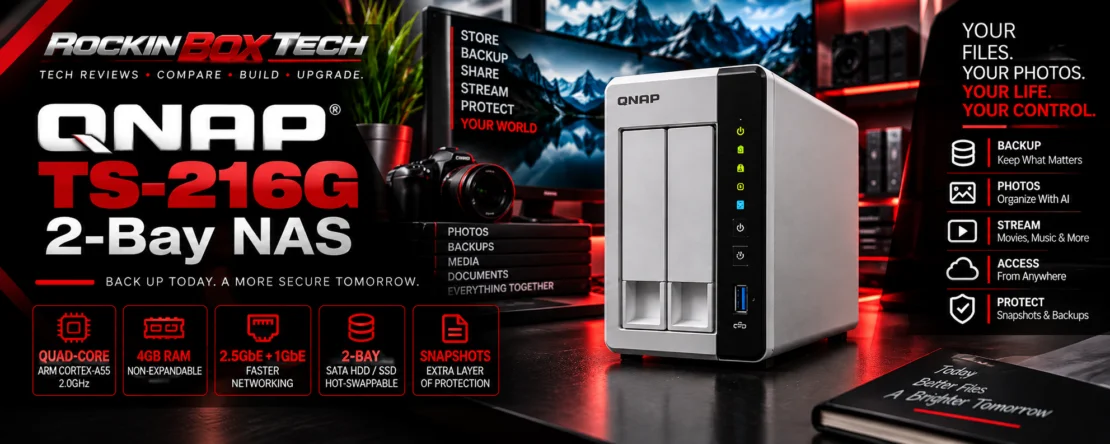
QNAP TS-216G 2-Bay NAS Review
Consumer-focused network storage combining 2.5GbE networking, two hot-swappable drive bays, 4GB RAM, snapshots, smart photo management and QNAP's extensive backup ecosystem.
What It Is
The QNAP TS-216G is a two-bay network-attached storage system designed primarily for homes, home offices and small working environments that want centralized backups, file sharing, private cloud storage and multimedia features.
Instead of connecting to only one computer like a conventional external hard drive, the TS-216G connects to the local network. Multiple compatible computers and mobile devices can then access shared files and backup services through QNAP's QTS software ecosystem.
The enclosure is sold without storage drives. Owners select compatible SATA hard drives or SSDs and choose a storage configuration based on their capacity and redundancy requirements.
Key Specifications
| Model | QNAP TS-216G |
|---|---|
| Drive Bays | 2 × SATA 6Gb/s / 3Gb/s |
| Drive Compatibility | 3.5-inch SATA HDDs and 2.5-inch SATA SSDs |
| Hot Swappable | Yes |
| Processor | 64-bit ARM Cortex-A55 — 4 cores at 2.0GHz |
| Graphics | Mali-G52 |
| Neural Processing Unit | Yes — hardware acceleration for supported AI workloads |
| Hardware Transcoding | Supported |
| Memory | 4GB onboard RAM |
| Memory Expansion | Not expandable |
| Flash Memory | 4GB with dual-boot OS protection |
| Networking | 1 × 2.5GbE + 1 × 1GbE |
| USB | 1 × USB 3.2 Gen 1 + 2 × USB 2.0 |
| USB Copy Button | Yes |
| Operating System | QNAP QTS |
| RAID Options for 2 Bays | Single / JBOD / RAID 0 / RAID 1 |
| Dimensions | 165 × 102 × 220.6 mm |
| Net Weight | 1.45 kg / approximately 3.2 lb |
| Typical Operating Power | 13.907W in QNAP's fully populated test configuration |
| Standard Warranty | 2 years |
Why the TS-216G Stands Out
2.5GbE Networking
Multi-gig Ethernet gives the NAS considerably more network bandwidth than a conventional Gigabit-only system when the switch, router and client devices also support 2.5GbE.
Two Network Ports
In addition to 2.5GbE, QNAP includes a separate Gigabit Ethernet connection, adding network flexibility not found on every entry-level two-bay NAS.
Built-In NPU
The neural processing unit accelerates supported AI workloads, including QNAP's face and object recognition used for smart photo organization.
Snapshot Protection
QTS supports snapshots that can preserve earlier states of supported storage, adding another recovery layer beyond simple file copying.
USB Copy Button
A dedicated USB Copy control provides a convenient path for configured transfers between compatible external USB storage and the NAS.
Established Backup Ecosystem
QNAP supports local, remote and cloud-oriented backup workflows, including Hybrid Backup Sync and Apple Time Machine support.
Real-World Performance Context
QNAP publishes controlled laboratory results for the TS-216G that demonstrate why its 2.5GbE connection matters. Those figures are useful for understanding the platform's potential, but they should not be treated as guaranteed speeds for every home network.
Sequential Read
QNAP measured approximately 291 MB/s SMB sequential download throughput in its specified 2.5GbE test environment.
Sequential Write
QNAP measured approximately 288 MB/s SMB sequential upload throughput under the same controlled test conditions.
Encrypted Transfers
QNAP's published laboratory test also reached approximately 288 MB/s in both directions with encryption enabled in that specific configuration.
What Consumers Get From QTS
Computer Backup
QNAP's software ecosystem supports backup workflows for computers as well as Apple Time Machine backup.
Phone Photo Backup
Qfile Pro and QuMagie Mobile can automatically upload supported mobile photos to the NAS, helping move personal libraries away from limited phone storage.
Hybrid Backup Sync
HBS supports NAS-to-NAS backup, cloud backup, cloud synchronization, active synchronization and external-drive backup workflows.
QuMagie Photos
QNAP's photo-management software can organize personal photo libraries and use the TS-216G's NPU to accelerate supported face and object recognition.
File Synchronization
Qsync provides synchronization capabilities across supported Windows, macOS, Ubuntu, Android and iOS devices.
Remote File Access
QNAP provides tools for reaching stored files from supported remote devices, giving the NAS private-cloud-style functionality.
What Reviewers & Users Are Saying
The TS-216G does not have the same enormous exact-model retail review pool as mainstream portable hard drives, so we do not treat its consumer feedback as statistically equivalent. The useful pattern comes from combining available owner discussion with independent reviews and the established QNAP user community.
2.5GbE Is a Major Positive
Faster networking is one of the most consistently highlighted strengths because it removes the traditional Gigabit ceiling when the rest of the network is properly equipped.
Backup Features Are Extensive
QNAP's broad selection of local, external, remote and cloud backup tools gives consumers considerably more flexibility than a basic external drive.
Photo Management Is a Real Focus
Mobile auto-upload, QuMagie and NPU-assisted recognition make family photo backup and organization a particularly prominent TS-216G use case.
Hardware Is Well Targeted
Independent reviews generally describe the quad-core ARM platform and 4GB RAM as appropriate for home storage, backup and multimedia workloads.
QTS Offers Depth
QNAP provides a large number of storage, synchronization, multimedia and administration features, which appeals to users who want substantial control over their NAS.
Depth Also Means Complexity
That flexibility can make QTS feel more involved than a basic consumer backup device. First-time NAS owners should expect configuration and maintenance beyond simply plugging in a USB hard drive.
What People Can Use It For
Family Photo Backup
Automatic mobile upload and AI-assisted organization make the TS-216G particularly relevant to households trying to protect growing phone-photo libraries.
PC & Mac Backups
Multiple computers can use centralized network storage rather than depending on a separate USB drive for every machine.
Private Cloud Storage
Consumers can maintain files on hardware they control while retaining supported local and remote access.
Media Libraries
Hardware-accelerated transcoding and QNAP multimedia tools make the system suitable for supported home-media workloads.
External-Drive Backup
USB connectivity, the USB Copy button and HBS allow compatible external storage to become part of a broader backup strategy.
Small Office Files
Shared folders, synchronization, snapshots and network access make the TS-216G useful beyond purely personal storage.
How It Fits Against Our Other NAS Picks
QNAP TS-216G
Strong emphasis on backup flexibility, snapshots, photo management, 2.5GbE plus 1GbE connectivity and a broad QTS feature set.
Synology DS225+
Centers its appeal around Synology's long-established DSM ecosystem, polished first-party applications and straightforward household and small-office storage management.
UGREEN DXP2800
Takes the hardware-value route with an Intel N100, 8GB DDR5, dual M.2 expansion and strong home-server flexibility, paired with a younger software ecosystem.
Strengths & Limitations
Strengths
- 2.5GbE plus separate 1GbE networking
- 4GB RAM included
- Two hot-swappable SATA bays
- Built-in NPU for supported AI workloads
- Hardware-accelerated transcoding
- Snapshot support
- Extensive backup and synchronization tools
- Automatic mobile-photo backup options
- USB Copy button
- Established QTS software ecosystem
Limitations
- Storage drives must be purchased separately
- 4GB memory is not expandable
- No M.2 NVMe expansion slots
- ARM platform offers less flexibility for some advanced software than x86 alternatives
- QTS has more configuration complexity than a USB drive
- Only a 2-year standard warranty
- Exact-model long-term owner data remains limited
- RAID redundancy still does not replace backup
Works Best With
Family Backup & Photos
A strong fit for households that want computers and phones backing up to one centralized location while keeping personal photo libraries under their own control.
Home & Small Offices
Shared files, snapshots, synchronization and multi-device backup provide much broader protection and collaboration than one directly attached external drive.
Consumers Wanting Backup Flexibility
Local storage, external drives, other NAS devices and supported cloud services can all become parts of a more complete backup strategy.
RAID Is Not a Backup
Rockin Box Tech Summary
The QNAP TS-216G rounds out this category by providing a consumer-oriented NAS that focuses heavily on backup, file management, photos and multi-device storage rather than simply delivering the most aggressive hardware specifications.
Its 2.5GbE connection is meaningful rather than cosmetic. QNAP's own controlled testing demonstrates near-300 MB/s sequential SMB transfers in the company's specified SSD-based test environment, showing that the platform can take advantage of networking beyond ordinary Gigabit Ethernet when the rest of the system is capable.
The combination of snapshots, Hybrid Backup Sync, Time Machine support, mobile-photo backup, Qsync and USB Copy gives the TS-216G considerable flexibility as a backup appliance. The built-in NPU and QuMagie integration add another consumer-friendly angle for households with large photo libraries.
The tradeoffs are equally clear. Memory is fixed at 4GB, there are no M.2 expansion slots, and the ARM architecture is less flexible for some advanced applications than an Intel-based NAS. Consumers who prioritize raw hardware and home-server expansion may prefer another approach. Consumers looking for a feature-rich two-bay backup and private-storage platform have a substantially different reason to consider the TS-216G.
Research Disclosure: Rockin Box Tech reviews are research-driven. Information is compiled from manufacturer specifications, technical documentation, reputable independent testing and owner/community feedback. Rockin Box Tech does not represent that this product was physically tested unless explicitly stated. Manufacturer benchmark results are identified as such. Specifications, software features, compatibility and consumer feedback may change over time.