
Lian Li UNI FAN TL 120 Wireless Review
Review Overview
Performance & Appearance
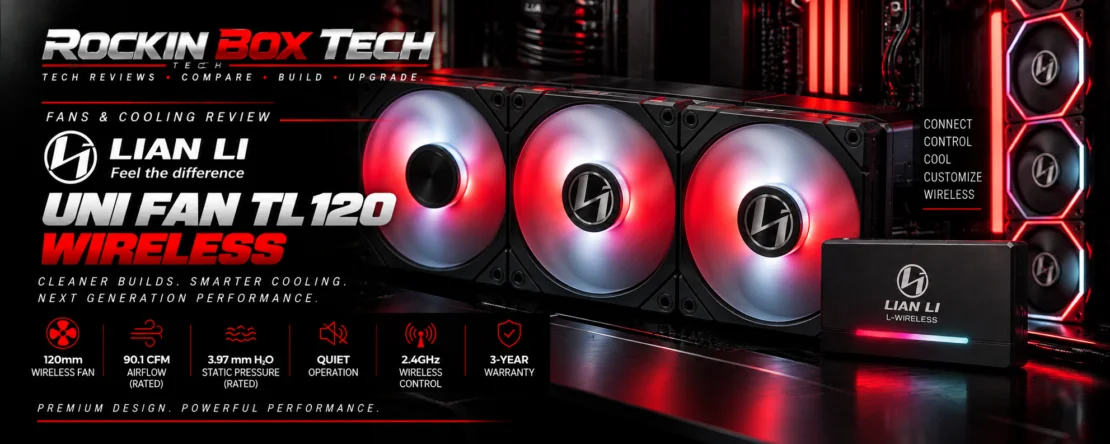
The TL 120 Wireless is designed to combine enthusiast-level visual presentation with meaningful cooling capability. Lian Li rates the standard-blade 120mm version for up to 90.1 CFM airflow and 3.97 mm H₂O static pressure.
Wireless Control
Lian Li's L-Wireless system uses a 2.4GHz signal to communicate lighting and fan-speed commands. This removes the traditional signal cable between each fan group and a conventional fan hub, although the fans still require electrical power.
UNI FAN Ecosystem
Multiple fans mechanically interlock into a cluster, reducing individual wiring. Standard and reverse-blade models, 120mm and 140mm sizes, black and white finishes, and LCD variants provide substantial configuration flexibility.
Verified Specifications
| Product | Lian Li UNI FAN TL 120 Wireless — Standard Blade |
|---|---|
| Dimensions | 120 × 124 × 28 mm |
| Fan Speed | 0 RPM / 200–2600 RPM |
| Maximum Airflow | 90.1 CFM |
| Maximum Static Pressure | 3.97 mm H₂O |
| Maximum Rated Noise | 33 dB(A) |
| Bearing | Fluid Dynamic Bearing (FDB) |
| Materials | PA66 / LCP |
| Connector | 4-pin PWM |
| Fan Voltage | DC 12V |
| LED Voltage | DC 5V |
| Input Power | 5.8W |
| Wireless Technology | 2.4GHz L-Wireless Sync |
| Lighting | Dual-zone addressable lighting |
| Colors | Black or White |
| Blade Options | Standard or Reverse Blade |
| Warranty | 3 years — fan and receiver |
Cooling Performance Design
90.1 CFM Rated Airflow
The standard TL 120 Wireless is rated for a maximum 90.1 CFM, giving it substantial airflow capability for a 120mm fan and making it appropriate for high-airflow intake and exhaust applications.
3.97 mm H₂O Pressure
Lian Li's 3.97 mm H₂O maximum static-pressure specification gives the standard TL 120 Wireless the pressure capability needed for restrictive applications such as radiators, filtered intakes and dense cooling surfaces.
LCP Impeller
Lian Li uses a large nine-blade impeller incorporating liquid-crystal-polymer material and tight blade-to-frame clearance. The design targets both high airflow and useful static pressure.
L-Wireless System
2.4GHz Communication
The L-Wireless controller communicates fan-speed and lighting commands using a 2.4GHz wireless signal. This reduces the number of control cables that must be routed back to a central hub.
Power Still Required
Wireless does not mean cable-free. Each fan group still requires power through a motherboard 4-pin PWM header or the supplied SATA power arrangement. Lian Li recommends SATA power when operating multiple fans for stable power delivery.
L-Connect 3
Lian Li's L-Connect 3 software provides control over fan speed and lighting behavior. Firmware should be updated during initial setup so the controller and fan receivers operate with current device support.
Interlocking Design & Installation
Reduced Cable Clutter
UNI FAN's interlocking architecture allows multiple adjacent fans to function as a connected cluster rather than requiring separate power and lighting cables from every fan. This can significantly simplify installations using three or more fans.
Check Case Clearance
At 120 × 124 × 28mm, the TL 120 Wireless is both slightly wider and thicker than a conventional 120 × 120 × 25mm fan. Builders should verify radiator, chassis and adjacent-component clearance before installation.
Standard vs. Reverse Blade
Standard TL 120 Wireless
The standard-blade version reviewed here operates from 200–2600 RPM, with a 0 RPM mode, and is rated for 90.1 CFM, 3.97 mm H₂O and 33 dB(A) maximum noise.
Reverse-Blade Alternative
Lian Li also offers a reverse-blade TL 120 Wireless for builds where the visually finished side of the fan should remain visible while airflow travels in the opposite direction. That version is rated for 200–2300 RPM, 83.4 CFM and 2.66 mm H₂O, so it should not be treated as thermally identical to the standard model.
Lighting & Visual Design
Dual-Zone Lighting
Separate lighting zones allow more complex effects than a basic single-zone RGB fan, giving the TL Wireless a strong visual role in showcase-oriented PC builds.
Aluminum Center Logo
Lian Li uses an aluminum center badge and premium exterior detailing rather than treating the fan purely as a functional cooling component.
Black & White Options
Both black and white versions are available, allowing the same fan ecosystem to fit dark performance builds or brighter showcase systems without changing the underlying cooling design.
Strengths & Limitations
Strengths
- Strong 90.1 CFM maximum airflow specification
- High 3.97 mm H₂O maximum static-pressure rating
- 0 RPM capability for low-load fan-stop operation
- 200–2600 RPM operating range
- Fluid Dynamic Bearing
- Interlocking UNI FAN cluster design reduces wiring
- 2.4GHz wireless control simplifies signal routing
- Dual-zone lighting and premium visual presentation
- Standard and reverse-blade configurations available
Limitations
- Wireless control still requires physical power wiring
- Single packs require a compatible L-Wireless controller purchased separately
- 120 × 124 × 28mm dimensions require more clearance than a standard 25mm-thick fan
- 33 dB(A) manufacturer maximum-noise rating reflects its high-output design
- Full functionality depends on Lian Li's controller and L-Connect 3 ecosystem
- Three-year warranty is shorter than some premium fan competitors
Works Best With
Showcase PC Builds
The combination of dual-zone lighting, interlocking construction and black or white finishes is especially well suited to glass-sided systems where fan appearance is part of the overall design.
360mm Radiators
Three-fan clusters combine the TL 120 Wireless interlocking design with substantial static-pressure capability for compatible 360mm liquid-cooling radiators.
Multi-Fan Systems
The wireless signal architecture and interconnected fan clusters become most useful in systems with numerous intake, exhaust and radiator fans where conventional wiring can quickly become complex.
Rockin Box Tech Summary
The Lian Li UNI FAN TL 120 Wireless approaches PC cooling differently from conventional premium fans. Its appeal is not based solely on airflow or acoustics; it combines substantial cooling specifications with an interconnected physical design, wireless control architecture and extensive visual customization.
The standard-blade model's rated 90.1 CFM airflow, 3.97 mm H₂O static pressure and 0 / 200–2600 RPM operating range give it the specifications needed for both chassis ventilation and restrictive radiator applications. Fluid-dynamic bearings and an LCP-based impeller further reinforce its performance-oriented design.
The tradeoff is ecosystem complexity. L-Wireless reduces signal cabling but does not eliminate power cables, single fans require a compatible controller, and full lighting and fan management relies on Lian Li's software environment. Its slightly oversized 28mm-thick frame also makes clearance checking important.
For builders already interested in Lian Li's UNI FAN ecosystem, especially multi-fan showcase systems, the TL 120 Wireless combines strong cooling specifications with one of its biggest practical advantages: reducing the cable clutter normally associated with elaborate RGB fan installations.