
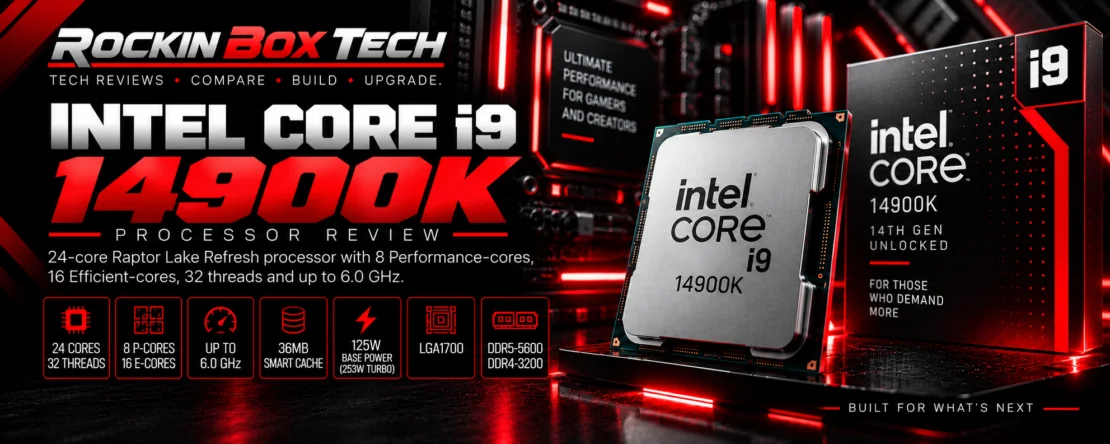
Intel Core i9-14900K
24-core Raptor Lake Refresh desktop processor with 8 Performance-cores, 16 Efficient-cores, 32 threads and up to 6.0 GHz.
Quick Product Overview
The Intel Core i9-14900K is a 14th-generation flagship desktop processor based on Intel's Raptor Lake Refresh architecture. It combines 8 Performance-cores with 16 Efficient-cores for a total of 24 physical cores and 32 processing threads.
Its headline specification is a maximum turbo frequency of 6.0 GHz using Intel Thermal Velocity Boost, making it one of the highest-clocked mainstream desktop CPUs of its generation.
In 2026, the 14900K remains a powerful gaming and productivity processor, but its high power consumption, older LGA1700 platform and required attention to current BIOS guidance are important considerations for buyers.
Key Specifications
| Processor | Intel Core i9-14900K |
|---|---|
| Generation | 14th Gen Intel Core |
| Architecture | Raptor Lake Refresh |
| Lithography | Intel 7 |
| Total Cores | 24 |
| Performance-cores | 8 |
| Efficient-cores | 16 |
| Total Threads | 32 |
| Maximum Turbo Frequency | Up to 6.0 GHz |
| Thermal Velocity Boost | Up to 6.0 GHz |
| Turbo Boost Max 3.0 | Up to 5.8 GHz |
| P-Core Maximum Turbo | Up to 5.6 GHz |
| E-Core Maximum Turbo | Up to 4.4 GHz |
| P-Core Base Frequency | 3.2 GHz |
| E-Core Base Frequency | 2.4 GHz |
| Intel Smart Cache | 36 MB |
| Total L2 Cache | 32 MB |
| Processor Base Power | 125W |
| Maximum Turbo Power | 253W |
| Socket | FCLGA1700 |
| Maximum Memory | 192 GB |
| Memory Support | Up to DDR5-5600 or DDR4-3200 |
| Memory Channels | 2 |
| Maximum Memory Bandwidth | 89.6 GB/s |
| PCI Express | PCIe 5.0 and PCIe 4.0 |
| Maximum CPU PCIe Lanes | 20 |
| Integrated Graphics | Intel UHD Graphics 770 |
| Graphics Max Dynamic Frequency | 1.65 GHz |
| Hyper-Threading | Yes |
| Intel Thread Director | Supported |
| Unlocked Multiplier | Yes |
| Maximum Operating Temperature | 100°C |
| Cooler Included | No |
| Launch | Q4 2023 |
Performance & Use-Case Information
Gaming
The 14900K remains a very fast gaming processor, particularly when paired with a high-end graphics card and fast memory.
Content Creation
Its 24-core hybrid design provides strong performance in rendering, encoding, editing and other heavily threaded creator applications.
Heavy Multithreading
Eight P-cores and sixteen E-cores allow the CPU to sustain a large number of simultaneous tasks, making it suitable for demanding productivity workloads.
Streaming
Intel Quick Sync and the high core count make the processor well suited to gaming, streaming and background processing at the same time.
High-Frequency Workloads
The 6.0 GHz peak turbo frequency gives the processor excellent performance in applications that respond strongly to high single-thread speed.
Mixed Workloads
The 14900K is best understood as an all-around enthusiast CPU capable of gaming, creation and productivity rather than a gaming-only specialist.
Power Efficiency & Thermals
Power consumption is one of the 14900K's most important tradeoffs. Intel specifies a 253W Maximum Turbo Power, and independent testing has shown that full-load system consumption can be very high.
TechSpot recorded the 14900K reaching Intel's 100°C TjMAX almost immediately during sustained all-core testing even with a 360mm liquid cooler, resulting in thermal throttling under that specific workload and test configuration.
For demanding productivity use, a strong 360mm-class liquid cooler, good case airflow and properly configured motherboard power settings are sensible considerations.
Platform & Compatibility
LGA1700 Socket
The 14900K uses Intel's LGA1700 socket and works with supported 600-series and 700-series desktop chipsets.
Z790 Platform
Z790 is the natural enthusiast pairing for an unlocked 14900K because it supports CPU, BCLK and memory overclocking.
Older Chipsets
Intel lists Z690, H670, B660, H610, Q670 and W680 among compatible 600-series chipset families. BIOS support should always be confirmed before installation.
DDR5 or DDR4
The processor supports either DDR5-5600 or DDR4-3200 depending on the motherboard, allowing both newer DDR5 systems and some DDR4 upgrade paths.
Current BIOS & Firmware Guidance
Intel currently recommends using the relevant Intel Default Settings in BIOS and installing the latest motherboard BIOS containing Microcode 0x12F or later.
Intel has also extended warranty coverage by two years for eligible processors affected by this issue, providing coverage of up to five years from the processor's original date of purchase.
Anyone buying or continuing to use a Core i9-14900K should therefore verify the motherboard manufacturer's latest BIOS before evaluating system stability or long-term operation.
Works Best With
These are examples of well-matched enthusiast components, not mandatory purchases. Always verify BIOS version, exact memory support, cooler mounting and case dimensions before buying.
MSI MAG Z790 TOMAHAWK MAX WIFI
A strong Z790 LGA1700 platform with DDR5 support and the power delivery appropriate for an unlocked Core i9-class processor. The latest BIOS should be installed before use.
G.SKILL Trident Z5 DDR5
A quality Intel XMP DDR5 kit is a strong match for a Z790 enthusiast build. Speeds above Intel's official DDR5-5600 specification are memory overclocking settings.
ARCTIC Liquid Freezer III 360
A high-capacity 360mm liquid cooler is a sensible choice for sustained Core i9 workloads, provided the computer case supports the radiator and LGA1700 mounting.
Intel UHD Graphics 770
The Core i9-14900K includes Intel UHD Graphics 770 with 32 execution units and a maximum dynamic frequency of 1.65 GHz.
The integrated GPU is useful for setup, troubleshooting, basic display output and Intel Quick Sync media acceleration. A discrete graphics card remains appropriate for a high-end gaming or creator build.
What Independent Reviewers Found
TechSpot
TechSpot found the 14900K only slightly faster than the previous 13900K in many workloads, emphasizing that Raptor Lake Refresh was largely an incremental update.
Gaming
Review coverage consistently places the 14900K among very fast gaming CPUs, but AMD's X3D processors can outperform it in a number of CPU-limited titles.
Power & Cooling
High power consumption and demanding thermal behavior are among the most frequently cited disadvantages in independent testing.
Where Reviewers Agree — And Where Context Matters
Where They Generally Agree
- Extremely strong overall performance
- Excellent multithreaded productivity capability
- Up to 6.0 GHz peak turbo frequency
- Strong high-end gaming performance
- Existing LGA1700 compatibility can reduce upgrade cost
- DDR5 and DDR4 support increase platform flexibility
Where Context Matters
- Performance gains over the 13900K are generally small
- Power consumption can be very high
- Cooling requirements are demanding
- AMD X3D CPUs can be faster in gaming
- LGA1700 has limited future upgrade potential
- Current BIOS and microcode guidance should be followed
Strengths & Limitations
Strengths
- 24 cores / 32 threads
- Up to 6.0 GHz
- Strong gaming performance
- Excellent creator and productivity capability
- 36MB Intel Smart Cache
- DDR5 and DDR4 support
- PCIe 5.0 support
- Intel UHD Graphics 770
- Unlocked multiplier
Limitations
- 253W Maximum Turbo Power
- Very demanding cooling requirements
- Incremental gain over Core i9-13900K
- AMD X3D alternatives can be faster for gaming
- Older LGA1700 platform
- BIOS / microcode maintenance is particularly important
- No boxed cooler included
Upgrade Considerations
From Core i9-13900K
The improvement is generally too small to make the 14900K a compelling replacement for a healthy 13900K solely for performance.
From 12th Gen Intel
Owners of compatible high-end LGA1700 motherboards may see a much larger performance increase while retaining the board and, in some systems, existing memory.
For New Builds
The 14900K makes the most sense when priced attractively or when a buyer specifically values its combination of high clocks, productivity performance and LGA1700 compatibility.
Alternatives to Consider
Intel Core i7-14700K
A less expensive LGA1700 alternative with strong gaming and productivity performance and lower purchase cost.
AMD Ryzen 7 9800X3D
A gaming-focused alternative with excellent efficiency and very strong CPU-limited gaming performance.
AMD Ryzen 9 9950X3D2
A newer high-end AMD alternative combining 16 Zen 5 cores with dual 3D V-Cache and an AM5 platform.
Who Is It Best For?
Creators & Power Users
Users running rendering, encoding, editing and other heavily threaded applications.
High-End Gaming + Work
Buyers who want one system capable of both high-end gaming and demanding productivity.
LGA1700 Upgraders
Existing Intel platform owners who can reuse a compatible motherboard and want one of the fastest CPUs available for it.
Rockin Box Tech Research Summary
Research from Intel's official documentation and independent testing shows the Core i9-14900K to be an extremely powerful but demanding enthusiast processor.
Its 24-core hybrid design, 32 threads and 6.0 GHz peak turbo provide excellent gaming, creator and productivity performance, but the performance increase over the previous 13900K is modest in many workloads.
Power consumption and cooling remain major considerations, and AMD's X3D processors can provide stronger gaming efficiency and performance in some titles.
In 2026, the 14900K makes the most sense as a high-end LGA1700 upgrade or when available at an attractive price. Current BIOS and Intel microcode guidance should be followed before evaluating system stability.