
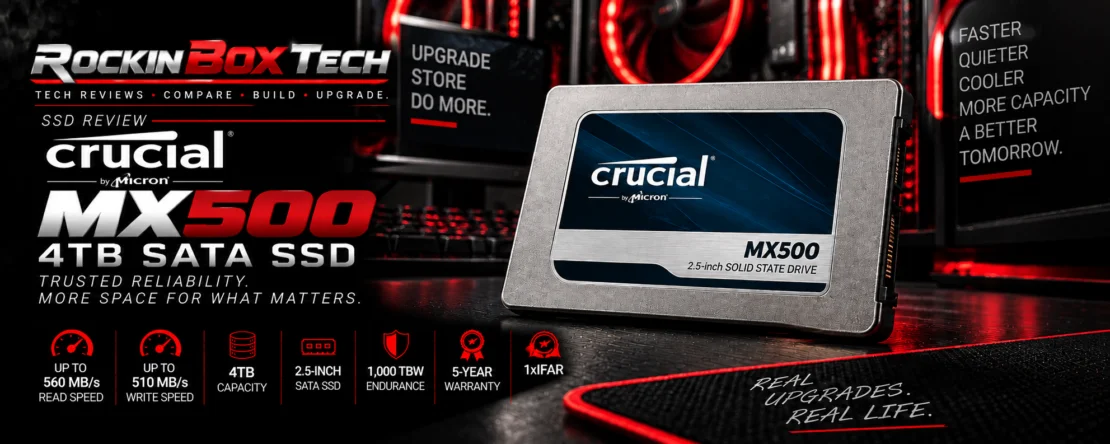
Crucial MX500 4TB SATA SSD Review
What Is the Crucial MX500 4TB?
High-Capacity SATA SSD
The MX500 4TB is a 2.5-inch SATA SSD designed for systems where PCIe NVMe storage is unnecessary, unavailable or already fully occupied.
A Different Kind of Upgrade
Its purpose is not to compete with PCIe 4.0 or PCIe 5.0 drives in raw throughput. It provides solid-state responsiveness through the extremely common SATA interface.
Useful 4TB Capacity
Four terabytes gives the MX500 enough capacity for large game libraries, media collections, applications and general-purpose local storage while eliminating the mechanical latency of a traditional hard drive.
Verified 4TB Specifications
| Product | Crucial MX500 |
| Capacity Reviewed | 4TB |
| Part Number | CT4000MX500SSD1 |
| Form Factor | 2.5-inch |
| Drive Height | 7mm |
| Interface | SATA 6Gb/s |
| Sequential Read | Up to 560 MB/s |
| Sequential Write | Up to 510 MB/s |
| Endurance | 1,000 TBW |
| Life Expectancy | 1.8 million hours MTTF |
| Operating Temperature | 0°C to 70°C |
| Warranty | 5-year limited warranty or rated TBW limit |
| Cloning Software | Acronis True Image for Crucial |
Why SATA Still Matters
Older Systems
Millions of desktop and laptop systems support SATA but either lack an M.2 NVMe slot or have limited NVMe expansion. A 2.5-inch SSD can provide a substantial responsiveness upgrade without replacing the entire system.
Secondary Storage
Modern desktops frequently have several SATA connections even after their M.2 slots are occupied, making a 4TB SATA SSD useful as quiet secondary solid-state storage.
Hard-Drive Replacement
Replacing a mechanical system drive with an SSD removes seek latency and can dramatically improve booting, application launches and general system responsiveness.
Performance
Up to 560 MB/s Read
Crucial rates sequential reads at up to 560 MB/s, which places the MX500 close to the practical performance limit of the SATA 6Gb/s interface.
Up to 510 MB/s Write
Sequential writes are rated at up to 510 MB/s. That is far below modern NVMe throughput but appropriate for a high-performance SATA SSD.
SATA Is the Limiting Factor
The MX500 cannot approach multi-gigabyte-per-second NVMe speeds because SATA itself is the primary bandwidth limitation. That does not prevent it from providing the low access latency associated with solid-state storage.
1,000 TBW Endurance
Capacity-Specific Rating
The 4TB MX500 carries a 1,000 TBW endurance rating. Crucial equates this to approximately 547GB of writes per day for five years.
Five-Year Limited Warranty
Warranty coverage lasts five years from the original purchase date or until the drive reaches its published maximum TBW rating, whichever occurs first.
Data Protection Features
RAIN
Crucial lists Redundant Array of Independent NAND technology among the MX500's advanced features, adding another layer to the drive's internal data-protection architecture.
Integrated Power-Loss Immunity
The MX500 includes integrated power-loss immunity intended to help protect data integrity if power is unexpectedly interrupted.
SMART, TRIM and ECC
Crucial also lists SMART monitoring, TRIM support, active garbage collection and error-correction technology among the MX500's advanced features.
Dynamic Write Acceleration
High-Speed Write Buffering
Crucial uses Dynamic Write Acceleration to improve burst write performance by allowing part of the NAND to operate as a faster write buffer.
Sustained Workloads Are Different
As with other consumer SSD caching systems, short burst transfers and prolonged sustained writes should not be treated as identical workloads. Available free space and drive state can affect write behavior.
Independent Technical Perspective
A Mature SATA Platform
Independent testing of earlier MX500 capacities established the family as a strong mainstream SATA performer with competitive responsiveness, endurance and software support. :contentReference[oaicite:4]{index=4}
Near the SATA Ceiling
The MX500's performance profile demonstrates why modern premium SATA SSDs tend to cluster around similar sequential speeds: the SATA interface becomes the limiting factor before modern NAND technology does.
Important Testing Limitation
Much of the detailed independent MX500 benchmark coverage predates the later 4TB model. Results from older 250GB, 500GB, 1TB and 2TB samples should therefore be treated as MX500 family context rather than direct benchmark measurements of this exact 4TB drive.
Desktop Upgrade Use
Easy SATA Expansion
Desktop systems with available SATA data and power connections can use the MX500 without consuming a motherboard M.2 slot or PCIe lanes.
Quiet High-Capacity Storage
With no mechanical platters or moving read heads, the MX500 provides silent storage and avoids the vibration associated with traditional hard drives.
Laptop Upgrade Use
7mm 2.5-Inch Format
The drive uses a standard 7mm 2.5-inch SATA form factor suitable for many laptops designed around replaceable SATA storage.
Check Physical Compatibility
Not every modern laptop includes a 2.5-inch SATA bay. Confirm the system has the required physical bay, connector and mounting arrangement before purchasing.
Cloning and Migration
Acronis Cloning Software
Crucial includes access to Acronis True Image for Crucial cloning software, which can simplify migration from an existing compatible storage device.
Useful for HDD Replacement
Cloning can allow an existing operating-system installation, applications and files to be transferred to the SSD rather than requiring a completely new software installation.
MX500 vs Modern NVMe SSDs
NVMe Wins Raw Speed
Modern PCIe 4.0 SSDs can exceed 7,000 MB/s and current PCIe 5.0 models can exceed 14,000 MB/s. The MX500's 560 MB/s maximum read specification cannot compete in sequential throughput.
SATA Wins Compatibility
SATA remains available in a huge number of older PCs and is still useful for adding storage when motherboard M.2 slots are unavailable or already occupied.
Different Purpose
The correct comparison is not simply which drive posts the highest benchmark number. The MX500 addresses systems and expansion scenarios where a 2.5-inch SATA device is the appropriate storage interface.
Owner and Community Perspective
Why Users Consider It
- Large 4TB solid-state capacity
- Broad SATA compatibility
- Near-interface-limit SATA performance
- 1,000 TBW endurance rating
- Five-year limited warranty
- Useful HDD replacement option
- 2.5-inch 7mm form factor
- Cloning software support
Common Considerations
- Far slower sequential throughput than NVMe
- SATA requires separate data and power connections in desktops
- Many new laptops no longer include 2.5-inch bays
- Not intended for users seeking maximum workstation throughput
- Value depends on the price difference versus modern NVMe drives
Strengths and Limitations
Strengths
- 4TB capacity
- Broad SATA 6Gb/s compatibility
- Up to 560 MB/s sequential read
- Up to 510 MB/s sequential write
- 1,000 TBW endurance rating
- Five-year limited warranty
- 1.8-million-hour MTTF specification
- Integrated data-protection features
- 7mm 2.5-inch form factor
- Acronis cloning software support
Limitations
- SATA bandwidth is dramatically lower than modern NVMe
- No PCIe/NVMe interface
- Not ideal for very high-throughput workstation workloads
- Requires a compatible 2.5-inch SATA connection
- Detailed independent testing of the exact 4TB version is limited
Works Best With
Older PC Upgrades
Desktop and laptop systems currently using a mechanical SATA hard drive or older lower-capacity SATA SSD.
Secondary SSD Storage
Modern desktops with occupied M.2 slots that still have available SATA connections for additional high-capacity solid-state storage.
Large Game and Media Libraries
Users who want 4TB of quiet solid-state storage without requiring the extreme sequential throughput of a premium NVMe drive.
Rockin Box Tech Summary
The Crucial MX500 4TB completes this ten-drive SSD lineup by representing a storage category that the PCIe 5.0 flagships cannot: high-capacity 2.5-inch SATA solid-state storage.
Its specifications are modest beside modern NVMe hardware—up to 560 MB/s reads and 510 MB/s writes—but those numbers are appropriate for the SATA 6Gb/s interface. The 4TB model also carries a 1,000 TBW endurance rating, a five-year limited warranty and Crucial's established collection of data-integrity and drive-management features. :contentReference[oaicite:7]{index=7}
The MX500 makes the most sense when interface compatibility, capacity and solid-state responsiveness matter more than benchmark-leading bandwidth. For upgrading a SATA-based PC, replacing a mechanical hard drive or adding 4TB of secondary SSD storage without consuming another M.2 slot, it fills a role that remains practical even in the NVMe era.