
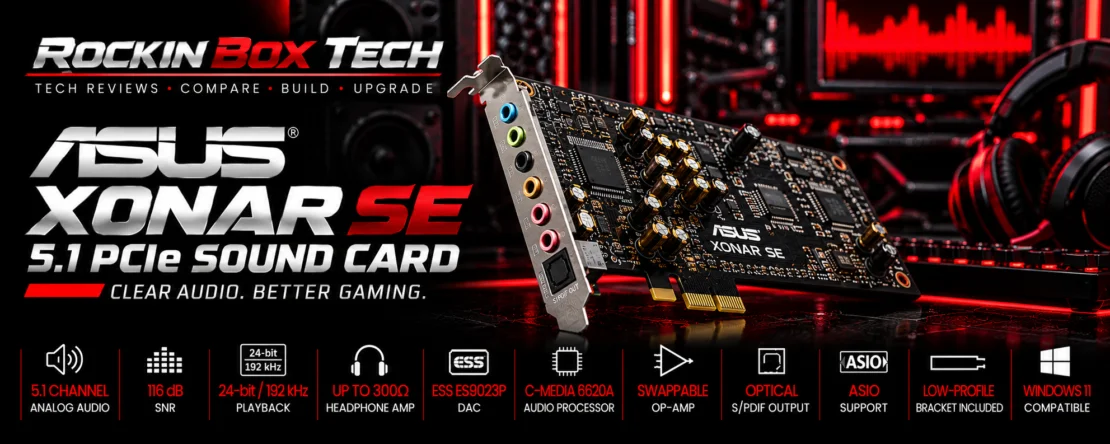
ASUS Xonar SE 5.1 PCIe Sound Card Review
An affordable internal PCIe sound card offering 5.1-channel analog audio, 24-bit / 192 kHz playback, 116 dB SNR, optical output and a built-in headphone amplifier for current Windows PCs.
What It Is
The ASUS Xonar SE is an internal PCI Express sound card designed as an affordable upgrade from motherboard audio. Rather than competing directly with expensive enthusiast cards, it focuses on the features many desktop users actually need: analog surround output, headphone amplification, optical digital output and high-resolution playback.
ASUS specifies 5.1-channel output, playback up to 24-bit / 192 kHz and a 116 dB signal-to-noise ratio. A built-in headphone amplifier is designed to support headphones rated up to 300Ω.
The Xonar SE also includes a low-profile bracket, making it suitable for both conventional desktop towers and compatible compact PCs with an available PCIe slot.
Key Specifications
| Model | ASUS Xonar SE |
|---|---|
| Interface | Internal PCI Express |
| Channels | Up to 5.1-channel analog output |
| Maximum Playback | Up to 24-bit / 192 kHz |
| Signal-to-Noise Ratio | 116 dB |
| THD+N | 0.00251% (-92 dB) |
| Audio Processor | C-Media 6620A |
| D-A Converter | Realtek S1220A |
| A-D Converter | Realtek S1220A |
| Headphone Output Power | 2 Vrms (5.65 Vp-p) |
| Headphone Amplifier | Designed for headphones up to 300Ω |
| Analog Outputs | Front, side surround and center/subwoofer 3.5 mm outputs |
| Audio Input | 3.5 mm line-in / microphone input |
| Digital Output | Optical TOSLINK S/PDIF output |
| Front Panel | Front-panel audio header |
| ASIO | Supported |
| Official Driver Options | Windows 8.1, Windows 10 and Windows 11 64-bit support available from ASUS |
| Included Accessory | Low-profile bracket |
116 dB Audio Performance
ASUS rates the Xonar SE at a 116 dB signal-to-noise ratio. The card uses a C-Media 6620A audio processor with Realtek S1220A conversion hardware.
116 dB SNR
The published signal-to-noise specification gives the Xonar SE considerably more audio headroom than the specifications historically associated with inexpensive onboard solutions.
24-bit / 192 kHz
High-resolution playback support covers common lossless music, gaming and multimedia requirements without chasing unusually high sample-rate specifications simply for marketing value.
Hyper Grounding
ASUS uses its Hyper Grounding PCB design to help isolate signals and reduce interference and component crosstalk.
Built-In Headphone Amplifier
The Xonar SE includes a dedicated headphone amplifier designed for headphones with impedance ratings up to 300Ω.
Up to 300Ω
This gives the card more flexibility with demanding wired headphones than a basic low-power motherboard headphone jack.
2 Vrms Output
ASUS specifies headphone output power at 2 Vrms, providing a useful reference for comparing the Xonar SE with other internal cards and onboard audio solutions.
5.1 Analog Surround
The Xonar SE provides dedicated 3.5 mm analog outputs for front, side surround and center/subwoofer channels, allowing it to drive a traditional 5.1-channel powered PC speaker system.
Direct Analog Connections
Users with conventional multichannel PC speakers do not need to route their audio through HDMI simply to obtain discrete analog surround output.
Gaming & Movies
The 5.1 layout is particularly useful for desktop gaming, movies and older surround speaker systems that rely on analog connections.
Optical S/PDIF Output
An optical TOSLINK S/PDIF output allows the Xonar SE to connect digitally to compatible receivers, DACs and speaker systems.
This provides useful flexibility for a PC that needs both direct analog outputs and a digital audio connection.
Current Windows Compatibility
Operating-system support matters considerably for an internal sound card because the hardware depends on drivers and control software to expose its features correctly.
Windows 11
ASUS's current Xonar SE support page includes Windows 11 64-bit as an operating-system selection and provides the ASUS Xonar SE audio driver.
Windows 10
Windows 10 32-bit and 64-bit driver options are also listed by ASUS.
Windows 8.1
ASUS also maintains Windows 8.1 driver options, satisfying the minimum operating-system generation required for this Rockin Box Tech review category.
Low-Profile PC Support
ASUS includes a low-profile bracket with the Xonar SE. That expands its usefulness beyond full-size gaming towers.
Full-Size Desktops
The standard configuration works in conventional desktop cases with an available compatible PCIe slot.
Compact Builds
The included low-profile bracket makes the card a potential option for compatible small-form-factor systems where expansion space is limited.
Xonar Audio Center
ASUS provides Xonar Audio Center software for configuration of the card's audio functions, including equalization and speaker settings.
This software layer provides more control than a completely basic audio device, but it is also one of the areas where owner experience becomes important.
What Owners Are Saying
Available exact-model owner feedback shows why the Xonar SE is useful to evaluate from both a hardware and software perspective. Positive comments commonly focus on improved sound compared with motherboard audio, value and straightforward physical installation.
Sound Upgrade
Several owners describe the Xonar SE as a noticeable improvement over the onboard audio they replaced, particularly when used with appropriate speakers or headphones.
Value
Its relatively simple feature set and affordable positioning appeal to users who need a dedicated internal card without paying for enthusiast-level hardware.
Software Complaints
Owner experience is not universally positive. Some feedback describes configuration or software behavior as frustrating, including output settings that may require additional attention after installation or restart.
Where an Internal Xonar SE Still Makes Sense
Failed or Weak Onboard Audio
It provides a straightforward replacement when motherboard audio is damaged, noisy or otherwise inadequate.
Analog 5.1 Users
PCs using traditional powered 5.1 speaker systems can benefit from the card's dedicated analog outputs.
Wired Headphones
The integrated amplifier makes the card more relevant to users with wired headphones that need more output than their motherboard provides.
Optical Audio
The TOSLINK output provides a useful connection for compatible external audio equipment.
Compact PCs
Its included low-profile bracket expands compatibility with appropriately equipped smaller desktop cases.
Budget Upgrades
The Xonar SE targets users who need practical dedicated audio features without moving into premium sound-card pricing.
Strengths & Limitations
Strengths
- True internal PCIe sound card
- Official ASUS Windows 11 64-bit driver available
- Windows 10 and Windows 8.1 driver support
- 5.1-channel analog output
- Up to 24-bit / 192 kHz playback
- 116 dB signal-to-noise ratio
- Built-in headphone amplifier
- Designed for headphones up to 300Ω
- 2 Vrms headphone output specification
- Optical TOSLINK S/PDIF output
- ASIO support
- Front-panel audio header
- Hyper Grounding PCB design
- Low-profile bracket included
- Useful alternative to Creative's internal cards
Limitations
- Requires an available internal PCIe slot
- Limited to 5.1 rather than 7.1 analog output
- No premium desktop control module
- Less powerful headphone stage than some premium cards
- Software experience receives mixed owner feedback
- Optical S/PDIF does not support every modern audio format
- Modern premium motherboard audio may already satisfy some users
- Technical specifications alone do not guarantee an audible upgrade
Works Best With
5.1 PC Speakers
A practical match for traditional powered analog surround systems using separate front, surround and center/subwoofer connections.
Wired Headphones
Users with headphones that benefit from dedicated amplification can take advantage of the integrated headphone amp.
Current Windows Desktops
Official Windows 11 driver availability keeps the Xonar SE relevant for modern PCs rather than restricting it to legacy-system builds.
Rockin Box Tech Summary
The ASUS Xonar SE fills a very different position from the premium Creative cards at the beginning of this review series. It is a simpler and more affordable internal PCIe solution focused on practical desktop audio rather than flagship specifications.
Its combination of 5.1 analog output, 24-bit / 192 kHz playback, 116 dB SNR, optical output and a headphone amplifier rated for headphones up to 300Ω gives it a useful feature set for gaming, music and general desktop entertainment.
Modern compatibility is especially important. ASUS currently provides a Windows 11 64-bit driver option for the Xonar SE, alongside Windows 10 and Windows 8.1 support. That is a major reason this older design can still qualify for a current Rockin Box Tech review.
Owner feedback reinforces both sides of the story. Users often praise the improvement over basic onboard audio and the card's value, while software and configuration complaints show that dedicated PC audio still depends on more than the quality of the hardware alone.
The Xonar SE therefore makes the most sense for someone who has a specific reason to add a sound card: analog 5.1 speakers, optical output, wired headphone amplification, failed onboard audio or a compact PC that can use its low-profile bracket.
It also gives this Rockin Box Tech category its first non-Creative selection, beginning the broader manufacturer mix that will continue through the remaining internal sound cards.
Research Disclosure: Rockin Box Tech reviews are research-driven. Technical information is compiled from current manufacturer specifications, official driver and support pages, documentation, independent information and available consumer feedback. Rockin Box Tech does not represent that this product was physically tested unless explicitly stated. Manufacturer specifications are treated as technical claims, while owner and community comments are treated as anecdotal consumer experience rather than controlled testing. Drivers, software, compatibility, pricing and availability may change over time.