
ASUS Strix Soar 7.1 PCIe Gaming Sound Card Review
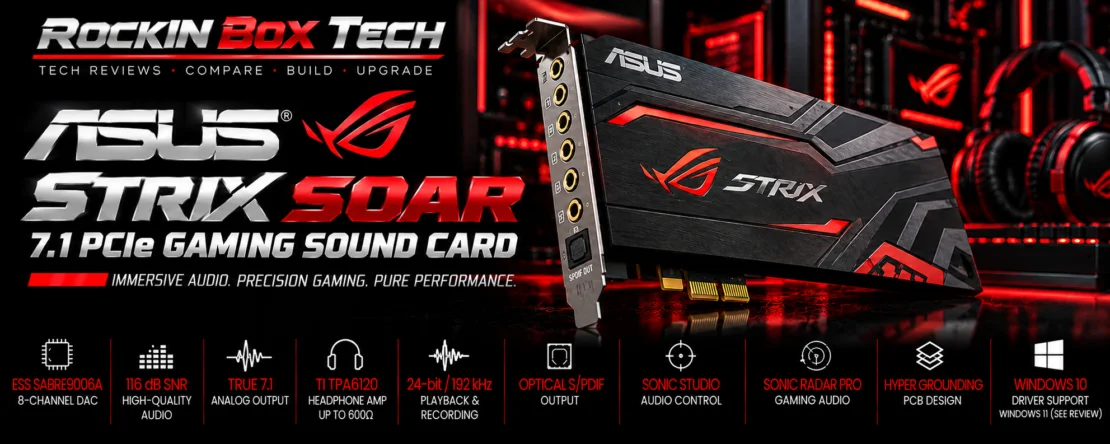
A gaming-focused internal PCIe sound card combining true 7.1-channel analog output, an ESS SABRE9006A DAC, 116 dB SNR, 24-bit / 192 kHz audio and headphone amplification for headphones up to 600 ohms.
What It Is
The ASUS Strix Soar is an internal PCI Express gaming sound card designed for desktop users who want dedicated analog surround audio, stronger headphone amplification and more audio control than a typical motherboard implementation provides.
Its hardware combines a C-Media 6632AX high-definition audio processor with an ESS SABRE9006A 8-channel DAC and Cirrus Logic CS5361 analog-to-digital converter.
Unlike sound cards that advertise 7.1 primarily through headphone virtualization, the Strix Soar provides physical analog connections for a true 7.1-channel speaker configuration.
Key Specifications
| Model | ASUS Strix Soar |
|---|---|
| Interface | PCI Express |
| Bus Compatibility | PCIe v1.0 or above compatible |
| Audio Processor | C-Media 6632AX High-Definition Sound Processor |
| D-A Converter | ESS SABRE9006A Premier 8-channel DAC |
| A-D Converter | Cirrus Logic CS5361 |
| Analog Channels | Up to 7.1 discrete channels |
| Front Line-Out SNR | 116 dB A-weighted |
| Headphone-Out SNR | 110 dB A-weighted at 600Ω load |
| Line-In SNR | 110 dB A-weighted |
| Maximum Analog Playback | Up to 24-bit / 192 kHz |
| Maximum Analog Recording | Up to 24-bit / 192 kHz |
| Optical Output | S/PDIF output via combo connection |
| Headphone Amplifier | TI TPA6120 |
| Headphone Support | Optimized for 16Ω and 32–600Ω headphones |
| Output / Input Full-Scale Voltage | 2 Vrms (5.65 Vp-p) |
| Analog Input | 3.5 mm Line-In / Mic-In combo |
| ASIO | No |
| Official Driver Packages | Windows 10, Windows 8.1 and Windows 7 |
| Windows 11 | ASUS-documented use with latest Windows 10 driver |
ESS SABRE9006A DAC
At the center of the Strix Soar's analog playback section is an ESS SABRE9006A Premier 8-channel digital-to-analog converter.
Eight-Channel DAC
The SABRE9006A provides the conversion hardware required for the card's true multichannel analog output.
116 dB SNR
ASUS specifies a 116 dB A-weighted signal-to-noise ratio for the front line output.
Dedicated Audio Hardware
The Strix Soar uses a dedicated DAC architecture rather than relying entirely on the PC motherboard's integrated audio codec.
True 7.1-Channel Analog Audio
One of the Strix Soar's most important features is its physical support for discrete 7.1-channel analog speaker output.
Eight Analog Channels
Front, side, rear and center/subwoofer outputs allow connection to a compatible eight-channel analog speaker system.
No Virtual-Only Limitation
The card can provide a physical 7.1 speaker layout rather than relying solely on virtual surround processing through headphones.
24-bit / 192 kHz Playback & Recording
ASUS specifies analog playback and recording sample rates reaching 192 kHz with 24-bit resolution.
High-Resolution Playback
Compatible source material and software can use audio formats reaching 24-bit / 192 kHz.
High-Resolution Recording
The Cirrus Logic CS5361 ADC supports analog capture at sample rates reaching 192 kHz with 24-bit resolution.
Optical Output
The card's optical S/PDIF output supports compatible digital audio formats at sample rates reaching 192 kHz.
TI TPA6120 Headphone Amplifier
ASUS equips the Strix Soar with a Texas Instruments TPA6120 headphone amplifier designed to support a wide range of wired headphones.
Up to 600Ω
ASUS specifies headphone compatibility through 600 ohms, expanding the card's usefulness beyond basic gaming headsets.
Dedicated Headphone Output
The card includes a separate 3.5 mm headphone connection rather than requiring headphones to share a normal speaker line output.
2 Vrms
ASUS specifies a full-scale output/input voltage of 2 Vrms or 5.65 Vp-p for the Strix Soar hardware.
Optical S/PDIF Output
The Strix Soar provides digital optical S/PDIF output through a combo connection and supplied optical adapter.
External Digital Equipment
Compatible receivers, DACs and speaker systems can receive digital audio from the PC through the optical connection.
Up to 24-bit / 192 kHz
ASUS specifies optical output sample-rate support reaching 192 kHz for compatible PCM configurations.
Sonic Studio
ASUS Sonic Studio is the software control environment supplied for the Strix sound-card family.
Single Control Interface
Sonic Studio brings major output, volume, channel and processing settings together within one interface.
Equalization
Users can adjust EQ and create audio profiles for different games, music and entertainment applications.
7.1 Speaker Balancing
The software includes controls for balancing a multichannel speaker configuration.
Sonic Radar Pro
The Strix Soar was designed as a gaming sound card, and Sonic Radar Pro is one of ASUS's gaming-specific software features.
Sonic Radar can display an on-screen directional representation of selected in-game sounds such as footsteps, gunfire and other audio cues in supported configurations.
Hyper Grounding Technology
ASUS describes the Strix Soar as using its Hyper Grounding multi-layer PCB design to help separate and protect audio circuitry from electrical interference.
This is particularly relevant to internal sound cards because they operate inside an electrically active PC chassis alongside the motherboard, graphics card, power delivery hardware and other components.
Windows Compatibility
Operating-system support requires more explanation for the Strix Soar than for newer cards with dedicated Windows 11 packages.
Windows 10
ASUS provides dedicated Windows 10 32-bit and 64-bit driver packages for the Strix Soar.
Windows 8.1
Dedicated Windows 8.1 32-bit and 64-bit drivers are also available from ASUS.
Windows 11
ASUS does not list a dedicated Windows 11 driver package, but ASUS specifically documents Strix Soar operation after upgrading to Windows 11 and directs users to install the latest Windows 10 driver.
Aging Driver Package
The biggest qualification surrounding the Strix Soar is not its audio hardware. It is the age of its software support.
ASUS's latest listed Strix Setup package is version 1.1.23 from April 2021 and is categorized under Windows 10 rather than Windows 11.
Still Documented by ASUS
ASUS continues to maintain the Strix Soar product, manual and support pages and has published Windows 11-specific guidance for the card.
Not a Current Driver Platform
Buyers should understand that this is an older driver stack, not a sound card receiving a newly developed native Windows 11 driver package.
What Owners Are Saying
Consumer discussion around the Strix Soar reflects the same split visible in its specifications: the audio hardware remains capable, while software and long-term driver support are the more significant concerns.
Sound & Headphone Capability
Positive owner discussions commonly focus on the dedicated headphone amplification, multichannel connectivity and the improvement users experienced when replacing weaker onboard audio.
Useful 7.1 Connectivity
The true analog 7.1 outputs remain particularly relevant to users who still operate traditional multichannel PC speaker systems.
Driver & Software Concerns
The recurring caution is software support. Users considering the card for a current PC should place substantial weight on ASUS's aging driver package and Windows 11 installation requirements.
Where the Strix Soar Makes Sense
7.1 Analog Speaker Systems
True discrete 7.1 analog connectivity is one of the strongest reasons to consider the Strix Soar over simpler PCIe cards.
Higher-Impedance Headphones
The TI TPA6120 amplifier and published support through 600Ω provide considerably more headphone capability than generic expansion cards.
Windows 10 PCs
Windows 10 remains the cleanest officially packaged driver environment for this model.
Windows 11 Users Who Accept Older Drivers
ASUS provides a documented Windows 11 procedure, but buyers must be comfortable using the latest Windows 10 driver package.
Gaming Audio
Sonic Studio and Sonic Radar Pro provide gaming-oriented controls beyond basic playback functionality.
Systems Needing Dedicated Audio Hardware
The ESS DAC, Cirrus Logic ADC and dedicated headphone amplifier provide a more specialized audio architecture than a basic motherboard codec.
Strengths & Limitations
Strengths
- True internal PCI Express sound card
- ESS SABRE9006A 8-channel DAC
- C-Media 6632AX audio processor
- Cirrus Logic CS5361 ADC
- 116 dB front line-out SNR
- True discrete 7.1 analog output
- Up to 24-bit / 192 kHz analog playback
- Up to 24-bit / 192 kHz analog recording
- TI TPA6120 headphone amplifier
- Headphone support through 600Ω
- Dedicated headphone output
- Optical S/PDIF output
- Sonic Studio software
- Sonic Radar Pro gaming feature
- Hyper Grounding PCB design
- ASUS provides Windows 11-specific guidance
Limitations
- No dedicated native Windows 11 driver package
- Latest listed Strix driver package dates to 2021
- Windows 11 relies on ASUS's Windows 10-driver procedure
- No ASIO support listed by ASUS
- Optical connection is output rather than two-way S/PDIF I/O
- Requires an available PCIe expansion slot
- Software platform is older than current-generation alternatives
- Current exact-model consumer review evidence is limited
- Current retail availability may be limited
- Modern premium motherboard audio may already satisfy many users
Works Best With
7.1 Analog Desktop Audio
Users with traditional eight-channel PC speaker systems can take advantage of the Strix Soar's strongest connectivity feature.
Wired Enthusiast Headphones
The dedicated TI headphone amplifier makes the card particularly relevant when the motherboard struggles with more demanding wired headphones.
Users Comfortable Managing Drivers
The Strix Soar makes more sense for buyers willing to work with ASUS's established Windows 10 driver stack and documented Windows 11 procedure than for users wanting a completely current plug-and-play software platform.
Rockin Box Tech Summary
The ASUS Strix Soar closes this internal sound-card series with hardware that remains technically interesting even though its software platform is showing its age.
The ESS SABRE9006A DAC, C-Media 6632AX processor and Cirrus Logic CS5361 ADC give the card a substantial dedicated audio architecture. ASUS specifies a 116 dB front line-out SNR and analog playback and recording at resolutions reaching 24-bit / 192 kHz.
True 7.1 analog output is one of its biggest advantages. Unlike cards that use 7.1 primarily as a virtual headphone feature, the Strix Soar can physically connect a compatible eight-channel analog speaker system.
Headphone hardware is another strength. The TI TPA6120 amplifier supports headphones through 600 ohms, giving the Strix Soar more flexibility with wired headphones than inexpensive connectivity- focused PCIe cards.
Windows support is the major qualification. ASUS's current driver page provides dedicated packages through Windows 10, with the latest listed Strix Setup package dating to 2021. ASUS nevertheless specifically documents the Strix Soar under Windows 11 and directs affected Windows 11 users to the latest Windows 10 driver.
That makes the Strix Soar different from a completely abandoned legacy card, but it also prevents us from describing it as having a current native Windows 11 driver platform.
Current availability deserves similar caution. The card remains documented by ASUS, but retail stock is not as straightforward as it is for newer products. Buyers should verify both availability and their intended Windows configuration before purchasing.
For a desktop specifically needing true analog 7.1, strong wired- headphone amplification and ASUS's gaming-oriented audio controls, the Strix Soar still offers useful hardware. For a brand-new build where long-term driver development is the highest priority, its aging software stack is the most important limitation to weigh.
Research Disclosure: Rockin Box Tech reviews are research-driven. Technical information is compiled from current manufacturer specifications, manuals, driver/support information, independent sources where applicable and available consumer feedback. Rockin Box Tech does not represent that this product was physically tested unless explicitly stated. Manufacturer specifications are treated as technical claims, while owner reports are treated as anecdotal consumer experience rather than controlled testing. Driver support, operating-system compatibility, pricing and product availability may change over time.