
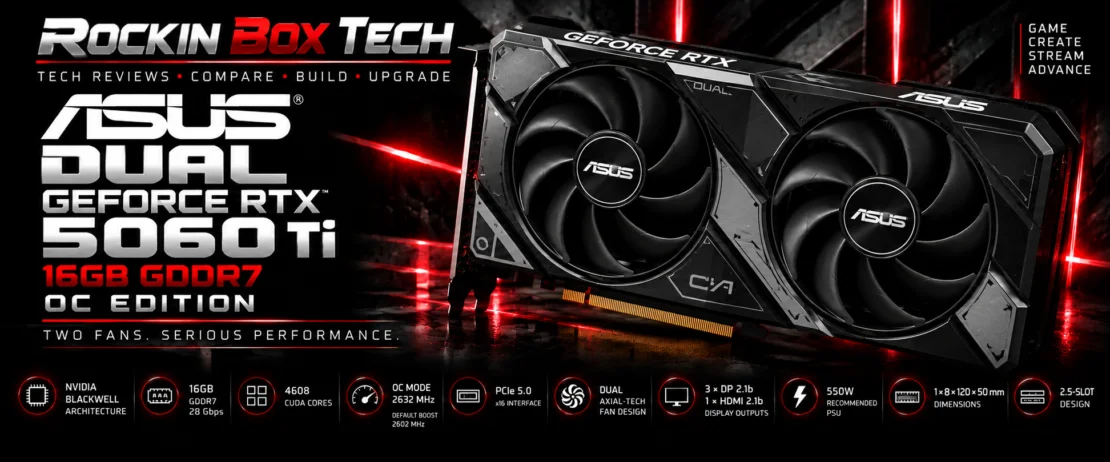
ASUS Dual GeForce RTX 5060 Ti 16GB GDDR7 OC Edition
Quick Product Overview
The ASUS Dual GeForce RTX 5060 Ti 16GB GDDR7 OC Edition is ASUS's compact dual-fan implementation of NVIDIA's Blackwell-based GeForce RTX 5060 Ti.
This model combines 16GB of 28 Gbps GDDR7 memory with 4608 CUDA cores and a 128-bit memory interface. ASUS specifies a default boost clock of 2602 MHz and an OC mode of 2632 MHz.
At 229 mm long and 2.5 slots thick, the ASUS Dual design is considerably more compact than many large triple-fan graphics cards while retaining 16GB of graphics memory and current RTX 50-series features.
Key Specifications
| Model | DUAL-RTX5060TI-O16G |
|---|---|
| Graphics Processor | NVIDIA GeForce RTX 5060 Ti |
| Architecture | NVIDIA Blackwell |
| CUDA Cores | 4608 |
| AI Performance | 759 TOPs |
| Default Boost Clock | 2602 MHz |
| OC Mode | 2632 MHz |
| Video Memory | 16GB GDDR7 |
| Memory Speed | 28 Gbps |
| Memory Interface | 128-bit |
| Bus Standard | PCI Express 5.0 |
| Digital Maximum Resolution | 7680 × 4320 |
| Maximum Displays | 4 |
| DisplayPort | 3 × DisplayPort 2.1b |
| HDMI | 1 × HDMI 2.1b |
| HDCP | 2.3 |
| OpenGL | OpenGL 4.6 |
| Card Dimensions | 229 × 120 × 50 mm |
| Slot Width | 2.5-slot |
| Recommended PSU | 550W |
| Power Connector | 1 × 8-pin |
Performance & Use-Case Information
1080p Gaming
The RTX 5060 Ti performance class is suited to high-quality and high-refresh-rate 1080p gaming, depending on the game and system.
1440p Gaming
The card is also applicable to 1440p gaming, with performance varying according to graphics settings, ray tracing and supported upscaling or frame-generation features.
16GB Video Memory
This version provides twice the graphics-memory capacity of the 8GB RTX 5060 Ti configuration, which can be useful in memory-heavy games and compatible creator workloads.
Blackwell Architecture
NVIDIA Blackwell provides the current RTX 50-series graphics architecture with current-generation Tensor and ray-tracing hardware.
DLSS Technologies
Compatible games can use current NVIDIA DLSS technologies for AI-assisted image reconstruction, ray reconstruction and supported frame-generation features.
Creator Applications
NVIDIA CUDA, Tensor and RTX hardware can accelerate compatible rendering, video, AI and other GPU-compute applications.
Cooling & Card Design
Dual Axial-tech Fans
ASUS uses two Axial-tech fans designed to provide concentrated airflow through the heatsink while keeping the card relatively compact.
2.5-Slot Cooler
The 50 mm-thick cooler occupies 2.5 expansion slots, providing additional heatsink volume compared with thinner dual-slot designs.
Compact 229 mm Length
At 229 mm long, the card is easier to accommodate in many compact cases than longer triple-fan graphics cards.
0dB Technology
ASUS incorporates fan-stop behavior under suitable low-load operating conditions to reduce unnecessary fan noise.
Dual BIOS
ASUS provides selectable performance and quiet BIOS profiles, allowing users to choose between different cooling behaviors.
Protective Backplate
The rear plate provides structural reinforcement while ventilation openings allow heated air to move through portions of the cooler.
Platform & Compatibility
PCI Express 5.0
ASUS specifies PCI Express 5.0 as the card's bus standard. Motherboard slot availability and physical clearance should be checked.
550W Recommended PSU
ASUS recommends a 550W power supply based on its fully overclocked GPU-and-CPU system configuration methodology.
Single 8-Pin Power
The ASUS Dual model uses one conventional 8-pin PCIe auxiliary power connection.
Compact Case Compatibility
Its 229 mm length can simplify installation in cases that cannot accommodate very long triple-fan graphics cards.
Four Display Outputs
Three DisplayPort 2.1b connections and one HDMI 2.1b connection support as many as four displays.
ASUS GPU Tweak III
ASUS supports the card with GPU Tweak III for compatible monitoring, tuning and graphics-card configuration functions.
Works Best With
Modern Mainstream CPU
A capable current processor helps prevent CPU-side limitations when targeting high frame rates at 1080p and 1440p.
Quality 550W+ PSU
ASUS recommends a 550W PSU. The system also needs one available 8-pin PCIe graphics power connection.
1080p / 1440p Display
This performance class is a practical match for high-refresh-rate 1080p and 1440p gaming displays.
Memory, Power & Display Connectivity
16GB GDDR7
Sixteen gigabytes of dedicated GDDR7 provides additional memory capacity for games and compatible GPU-accelerated workloads.
28 Gbps Memory
ASUS specifies 28 Gbps GDDR7 memory operating across a 128-bit interface.
PCI Express 5.0
The current-generation PCI Express interface connects the GPU to the motherboard platform.
1 × 8-Pin Power
A conventional single 8-pin PCIe connector supplies the card's auxiliary power.
3 × DisplayPort 2.1b
Three current-generation DisplayPort connections provide flexible monitor connectivity.
1 × HDMI 2.1b
HDMI 2.1b provides additional connectivity for compatible monitors, televisions and home-theater displays.
What Published Technical Information Shows
Factory-Overclocked Model
ASUS specifies 2602 MHz as the default boost clock and 2632 MHz when using its OC mode.
16GB RTX 5060 Ti
This version combines the RTX 5060 Ti GPU with 16GB of 28 Gbps GDDR7 rather than the alternative 8GB configuration.
4608 CUDA Cores
ASUS documents 4608 CUDA cores and an AI performance rating of 759 TOPs for this model.
Compact Dual Design
The 229 mm card length is substantially shorter than many current triple-fan graphics cards.
Current Display Outputs
Three DisplayPort 2.1b connections plus HDMI 2.1b provide four physical display outputs.
Conventional Power Connector
ASUS uses one standard 8-pin PCIe power connector rather than a 16-pin GPU power connection on this Dual model.
Where Research Agrees & Differs
Documented Hardware
ASUS documentation establishes the core specifications: RTX 5060 Ti, 4608 CUDA cores, 16GB GDDR7, 28 Gbps memory, 128-bit interface, PCIe 5.0 and a single 8-pin power connection.
Real-World Results Vary
Published gaming and application results vary with processor, game or application version, resolution, graphics settings, driver version, cooling and test methodology.
Strengths & Limitations
Strengths
- NVIDIA Blackwell architecture
- 16GB GDDR7 graphics memory
- 4608 CUDA cores
- 28 Gbps memory speed
- Factory-overclocked ASUS configuration
- 2632 MHz OC mode
- PCI Express 5.0
- Compact 229 mm card length
- Dual Axial-tech cooling fans
- Single conventional 8-pin power connector
- 3 × DisplayPort 2.1b
- 1 × HDMI 2.1b
Limitations & Planning Considerations
- 128-bit memory interface
- 2.5-slot thickness still requires expansion-slot clearance
- 550W recommended PSU should be considered during upgrades
- Performance varies substantially by game and graphics settings
- Actual boost frequencies depend on thermal and power conditions
- Ray tracing can increase GPU workload significantly
- 16GB model pricing should be compared with faster GPU tiers
- Retail pricing and availability can change quickly
Upgrade Considerations
16GB vs. 8GB
RTX 5060 Ti cards are available with different memory capacities. The 16GB model provides additional VRAM for memory-heavy games and compatible applications.
Check PSU Capacity
ASUS recommends a 550W PSU and requires one available 8-pin PCIe graphics power connection.
Compact Case Advantage
The 229 mm length can make this card easier to install in compact systems than many larger performance GPUs.
Alternatives to Consider
RTX 5060 Ti 8GB
The 8GB version can be compared where lower purchase cost is more important than the additional graphics-memory capacity.
Radeon RX 9060 XT 16GB
AMD's 16GB RDNA 4 alternative is worth comparing for raster performance, ray tracing, features and current pricing.
GeForce RTX 5070
NVIDIA's higher-tier RTX 5070 provides additional GPU resources for buyers who prioritize greater graphics performance.
Who Is It Best For?
1080p / 1440p Gamers
Users building current gaming systems around high-quality 1080p or 1440p displays.
16GB GPU Buyers
Buyers who want more graphics-memory capacity than the 8GB RTX 5060 Ti configuration provides.
Compact Gaming Builds
The 229 mm dual-fan design is particularly relevant where case length is more restricted.
Rockin Box Tech Research Summary
The ASUS Dual GeForce RTX 5060 Ti 16GB GDDR7 OC Edition combines NVIDIA's Blackwell RTX 5060 Ti with 16GB of GDDR7 memory and ASUS's compact dual-fan card design.
ASUS specifies 4608 CUDA cores, 28 Gbps GDDR7, a 128-bit memory interface, a 2602 MHz default boost clock and a 2632 MHz OC mode.
The card measures 229 × 120 × 50 mm, occupies 2.5 slots and uses one conventional 8-pin PCIe power connector. ASUS recommends a 550W power supply.
For buyers researching a compact RTX 5060 Ti with 16GB of graphics memory, this ASUS Dual model combines current Blackwell features, modern display connectivity and a comparatively short dual-fan design. Current pricing, system compatibility and competing GPUs should also be considered before purchase.
Research Sources
ASUS
ASUS Dual GeForce RTX 5060 Ti 16GB GDDR7 OC Edition official specifications, dimensions, clock speeds, display outputs, power requirements and card features.
NVIDIA
GeForce RTX 5060 Ti Blackwell architecture, RTX platform, graphics technologies and current driver information.
Research Disclosure
Products are not necessarily physically tested by Rockin Box Tech.
Graphics performance, clock speeds, temperatures, acoustics, power consumption and application performance can vary according to processor, motherboard, memory, BIOS, graphics driver, operating system, case airflow, cooling, power configuration, application or game version, graphics settings, resolution and operating conditions.
Product specifications, firmware and driver support, pricing and availability may change after this review is published.